



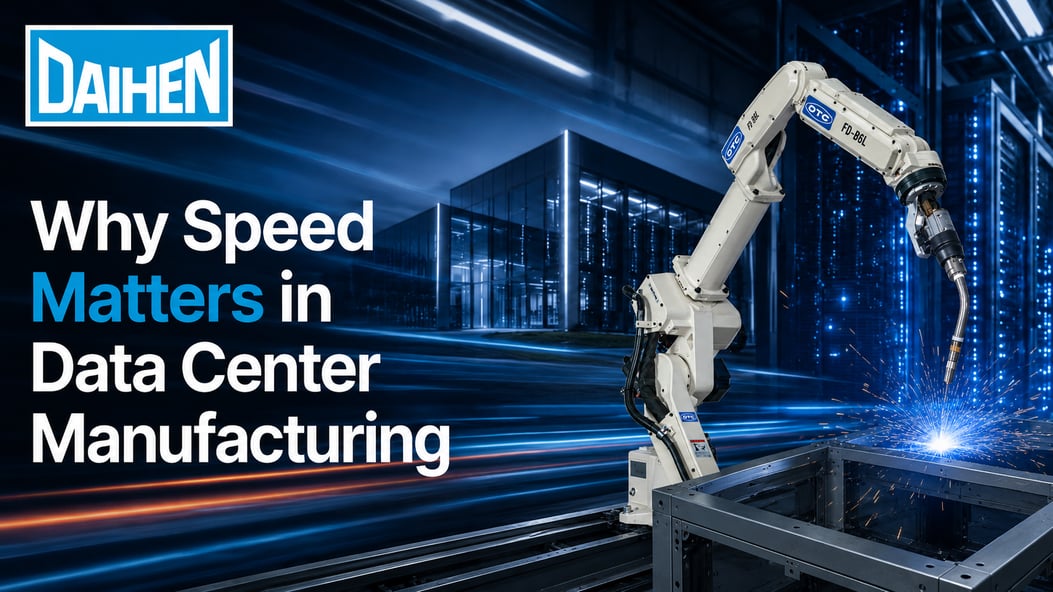
Artificial Intelligence is driving one of the largest infrastructure expansions in recent history.
Every day, new announcements emerge about hyperscale data centers, cloud computing investments, and AI-driven facilities designed to support growing digital demands. While much of the attention focuses on processors, software, and emerging technologies, another challenge is unfolding behind the scenes:
How quickly can the infrastructure be built?
For manufacturers supporting the data center industry, speed has become a competitive advantage. The organizations capable of delivering high-quality components, assemblies, and systems on aggressive timelines are helping shape the future of digital infrastructure.
The Race Is No Longer Just About Technology
A few years ago, conversations about AI centered around model performance, computing power, and software capabilities.
Today, the conversation has expanded.
The companies leading the AI race are also investing billions into physical infrastructure. New facilities require structural steel, electrical enclosures, power distribution equipment, cooling systems, modular assemblies, and countless fabricated components before a single server can come online.
In many cases, the challenge is no longer developing the technology—it is deploying the infrastructure fast enough to support it.
Why Data Center Timelines Are Shrinking
Demand for computing capacity continues to grow as organizations adopt AI, cloud services, automation, and data-intensive applications.
This growth creates pressure throughout the supply chain.
Project owners want facilities operational sooner. Contractors are working with tighter schedules. Manufacturers are expected to increase production without sacrificing quality or reliability.
The result is a manufacturing environment where delays can have a ripple effect across an entire project.
A late shipment of structural components, electrical enclosures, or cooling assemblies can impact installation schedules and potentially delay commissioning activities.
As project timelines continue to compress, manufacturers are being asked to do more in less time.
The Manufacturing Challenge
Meeting accelerated schedules is not simply about increasing output.
Manufacturers must balance three critical objectives simultaneously:
- Deliver products faster
- Maintain consistent quality
- Scale production efficiently
Accomplishing all three can be difficult, especially in industries facing skilled labor shortages and increasing demand.
Traditional production methods often struggle when workloads suddenly increase. Processes that work well for low-volume production may become bottlenecks when project requirements scale rapidly.
This is one reason many manufacturers are re-evaluating how products are fabricated, assembled, and delivered.
The Growing Role of Prefabrication and Modular Manufacturing
One of the most significant trends in data center construction is the shift toward prefabrication and modular manufacturing.
Rather than building every component on-site, manufacturers are increasingly producing assemblies in controlled environments before shipping them for installation.
This approach offers several advantages:
- Improved quality control
- Greater schedule predictability
- Reduced field labor requirements
- Faster deployment timelines
- Better repeatability across projects
For data center developers, modular construction helps accelerate project completion.
For manufacturers, it creates opportunities to standardize production processes and improve efficiency.
Automation as a Competitive Advantage
As production demands increase, many manufacturers are turning to automation to improve throughput and consistency.
Automation can help support:
- Repetitive fabrication processes
- Material handling operations
- Welding applications
- Assembly workflows
- Quality control initiatives
The goal is not simply to produce more parts.
The goal is to create reliable, repeatable processes capable of supporting growing production requirements while maintaining quality standards.
When schedules become tighter and customer expectations increase, process consistency becomes just as important as production speed.
Supply Chain Readiness Matters More Than Ever
Speed is not determined solely by what happens inside a manufacturing facility.
Supply chain readiness has become a critical factor in project success.
Manufacturers must coordinate materials, components, equipment, logistics, and production resources to ensure projects move forward without interruption.
Organizations that can quickly adapt to changing demand often gain a significant advantage in fast-moving markets such as data center construction.
The ability to respond, scale, and deliver consistently is becoming a key differentiator.
Looking Ahead
The future of AI depends on more than advanced algorithms and powerful processors.
It depends on the physical infrastructure that supports them.
As demand for data centers continues to grow, manufacturers will play an increasingly important role in determining how quickly new capacity comes online.
Success will require more than production volume alone. It will require efficient processes, scalable manufacturing strategies, supply chain readiness, and a commitment to quality.
In the race to build the next generation of digital infrastructure, speed matters—but only when it is supported by consistency, reliability, and execution.
Because in today's data center market, being able to build quickly is no longer an advantage.
It is an expectation.