



A robotic welding cell can look impressive on a specification sheet and still be the wrong fit for your production floor. The real buying decision is not simply which robot to choose. It is whether the complete system can handle your parts, meet your throughput goals, launch without unnecessary integration delays, and remain supportable as production changes.
For manufacturers, OEMs, distributors, and integrators, the better question is not, “What turnkey system should we buy?” It is, “How do we evaluate a turnkey system before it creates avoidable risk?”
That evaluation should start with the application, not the equipment list. Integration depth, commissioning readiness, part flow, tooling, changeover expectations, training, and long-term support all determine whether a system becomes a productive asset or another project your engineering team has to manage.
Key Takeaways: Evaluating Turnkey Welding Automation
- A turnkey cell should be evaluated on production fit and implementation risk, not price alone.
- Integration matters beyond the robot and welder. Positioners, sensors, software, tooling, and other external components also have to work together.
- High-mix production requires fixture flexibility, intuitive programming, sensing capability, and repeatable changeovers.
- Pre-engineered systems can provide a faster path to production when the application fits; custom systems address more specific production requirements.
- DAIHEN's Single-Source Solutions bring robotic welding equipment, welding process technology, positioning, training, and expert service and support into one coordinated approach.
Start With the Production Problem, Not the Robot
Before comparing robot payload, reach, or cycle speed, define the production constraint you are trying to solve. Is a manual welding station limiting throughput? Are experienced welders spending too much time on repetitive work? Is weld consistency changing from shift to shift? Or does a large weldment require positioning that is difficult to manage manually?
Consider two very different production floors. A manufacturer producing hundreds of similar brackets every shift may need to keep arc-on time high while operators load the next part. A fabricator welding long frames or tubular assemblies may care more about rotating the workpiece so every joint can be welded at the right torch angle.
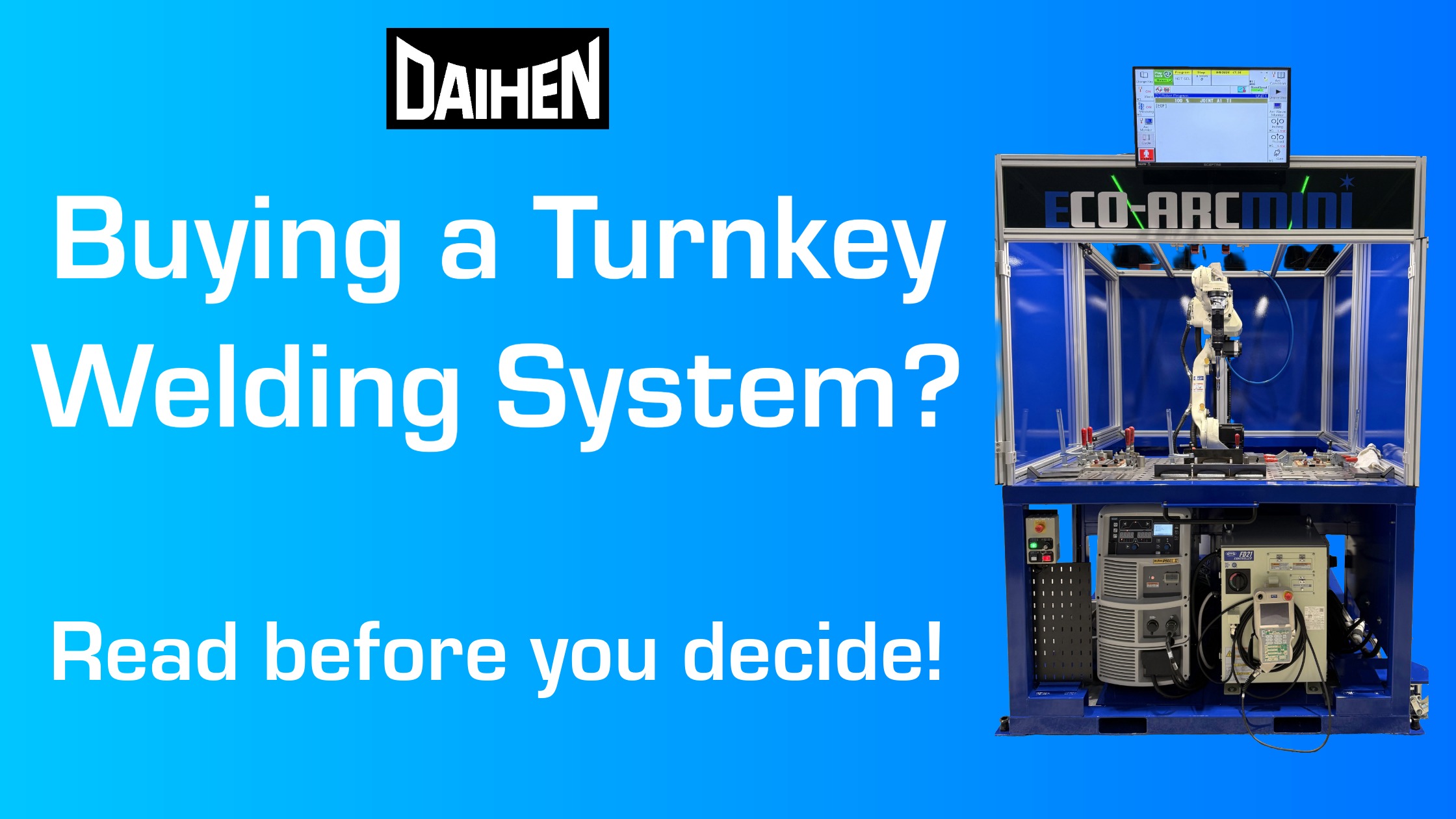
Those applications should not be forced into the same cell architecture. DAIHEN's ECO-ARC systems, for example, can provide an efficient path for smaller, repeatable weldments. DT-ARC configurations address applications where coordinated part positioning is central to the process. Higher-throughput production may call for TRI-ARC configurations that combine multiple robots and positioning strategies.
The product should follow the production problem - not the other way around.
How Do You Tell if a System Is Truly Turnkey?
Turnkey typically represents a robot system - whether pre-engineered or custom - delivered with the tooling solution and application elements required to perform the intended production task.
But not every packaged system offers the same level of integration. A complete turnkey application can include the robot, welding power source, wire feeder, torch, controller, safety package, positioner, tooling, sensors, software, and programming environment.
Imagine a cell where the robot comes from one manufacturer, the welding power source from another, the positioner from a third, and sensing hardware from a fourth. Each component may perform well independently. The challenge begins when they have to exchange commands, weld parameters, fault information, and motion data reliably.
A Single-Source Solution reduces those handoff points. It also gives the customer clearer ownership when an issue spans more than one component.
Look Beyond the Robot: Evaluate Integration Depth
Communication Between Core and External Components
Ask how the robot controller communicates with the welding power source, positioner, sensors, software, and other external components. Are the core elements designed to work together, or will gateways, custom interfaces, or additional programming be required? Every extra interface can add commissioning time and another point to troubleshoot later.
Coordinated Motion and Positioning
Part presentation can be just as important as robot motion. Long frames, pipe assemblies, cylindrical weldments, and multi-sided parts may need to rotate while the robot welds. In these applications, the robot and positioner should operate as a coordinated system so the weld joint can remain accessible and the torch can maintain a favorable orientation.
Welding Process Communication
The welding power source should also function as part of the robot environment, not as an isolated box. DAIHEN designs its robotic welding systems so the robot controller and Welbee welding power source operate within the same integrated environment, supporting process control, parameter management, diagnostics, and repeatable weld performance.
Evaluate the Entire Product Flow
A cell can be technically capable of welding a part and still create a bottleneck on the floor. Buyers should map how the part moves through the complete process: loading, fixturing, welding, unloading, and transfer to the next operation.
For smaller repeatable weldments, a two-station ECO-ARC configuration can allow an operator to unload and fixture a part on one side while the robot continues welding on the other. That overlap helps reduce robot idle time and keep production moving.
Longer weldments create a different challenge. Instead of forcing the robot to reach every joint around a stationary frame, a DT-ARC configuration can use coordinated positioning to rotate the workpiece and present the weld in a better orientation.
For higher-volume production, TRI-ARC configurations can support multiple robots and positioning so welding and load/unload activity occur efficiently within the same production system.
Floor space should therefore be evaluated as more than the outside dimensions of the cell. Look at operator access, fixture-change space, material-handling paths, finished-part flow, and upstream and downstream processes. A faster robot does not help if the cell is waiting for parts.
High-Mix Production Changes the Buying Criteria
A high-mix fabricator may run one part family in the morning and a completely different assembly after lunch. In that environment, shaving a few seconds from robot travel matters far less if every changeover requires an hour of programming and fixture adjustment.
Programming Simplicity
Look for a user-friendly programming environment that allows trained operators and welders to make routine changes without unnecessary complexity. Depending on the application, collaborative solutions such as DAIHEN's VC-Series can also provide a flexible automation path for operations that need easier redeployment or lower-volume production.
Fixture Flexibility
Dedicated tooling may make sense for a part that runs every day. It may not make sense for dozens of part numbers produced in smaller batches. Modular fixturing and repeatable locating methods can help the same automation investment serve a broader mix of work.
Tolerance to Real-World Variation
Parts do not always arrive exactly as modeled. Fit-up, fixture wear, joint location, and incoming material can vary. Ask how sensing and software options can help locate or track the joint when the application requires it. The goal is not simply automated motion; it is repeatable, high-quality welding under real production conditions.
Evaluate Commissioning Risk Before the Cell Ships
Many automation delays are not caused by the robot itself. They come from incomplete application planning, unclear startup responsibility, or integration work that was expected to happen after delivery.
Ask what is tested before shipment. Are robot motion, welding communication, positioner operation, safety functions, sensors, and software interfaces validated? If tooling or representative parts are available, what level of process validation can be completed before the cell reaches your facility?
Also clarify who owns installation, setup, process validation, and operator handoff. The fewer gray areas there are before shipment, the easier it is to build a realistic startup schedule.
Training Is Part of the Automation Investment
The first acceptable weld is not the end of an automation project. Operators change, new programmers join the team, part families evolve, and production may eventually ask the same cell to do work that was not part of the original launch.
DAIHEN's Free-For-Life Training Program supports continued development beyond initial installation, giving teams an avenue for refresher and advanced training as their people and applications evolve. Long-term automation value depends on the people who operate, program, maintain, and improve the system.
Support Matters Long After Installation
When production stops, the customer should not have to determine which supplier owns the problem before asking for help.
Before buying, ask who supports the robot, welder, torch, positioner, sensors, software, and external components. Ask how replacement parts are handled, what remote and on-site service options are available, and what resources exist for new operators and maintenance personnel.
DAIHEN's One Source Promise centers on providing robotic welding systems, power sources, accessories, training, and Expert Service and Support through one coordinated relationship. Fewer handoffs matter during commissioning - and they matter just as much years later when production needs support.
Red Flags to Watch for Before You Buy
- The supplier cannot clearly explain how the robot, welding power source, positioner, sensors, software, and external components are integrated.
- The proposed cell is presented as a universal solution without reviewing your actual parts, fixtures, weld access, or material flow.
- Testing and validation before shipment are vague.
- Support responsibility is fragmented across multiple vendors.
- Training is limited to basic startup with no path for future operators or programmers.
- The discussion centers on purchase price while giving little attention to commissioning, changeover, uptime, or long-term support.
These points do not automatically mean a project will fail. They are signals to ask better questions before the purchase order is issued.
Questions Every Buyer Should Ask Before Selecting a Turnkey Cell
- Which production problem is this cell specifically solving for us?
- How are the robot, welding power source, positioner, sensors, software, tooling, and other external components integrated?
- How will our parts be loaded, positioned, welded, unloaded, and moved to the next operation?
- What testing and validation are completed before shipment?
- How long should installation, startup, and process validation take?
- What training and support are included after commissioning?
- How will the system handle our current part mix and future production changes?
- Who owns troubleshooting when a problem spans multiple components?
How DAIHEN Approaches Turnkey Welding Automation
DAIHEN provides Integrated Solutions for manufacturers that need robotic welding systems built around performance, usability, and long-term support. As a global leader in robotic welding and welding technology, DAIHEN brings robots, welding power sources, torches, wire feeders, positioners, sensors, software, training, and service together around the application.
That Single-Source approach keeps the conversation focused on what ultimately matters: production fit, weld quality, implementation readiness, and the ability to support the system as manufacturing requirements evolve.
If you are evaluating turnkey welding automation, start with your parts and your production goals. The right solution is not simply the cell with the best specification sheet. It is the system that fits the process, integrates cleanly, gets into production with confidence, and continues delivering value after installation.
FAQs About Evaluating Turnkey Welding Automation
What is the difference between a turnkey welding system, a pre-engineered system, and a custom integration?
Turnkey typically refers to a complete robot system, whether pre-engineered or custom, delivered with the tooling solution needed for the application. A pre-engineered welding system is designed and built to fit a broad range of common applications and can offer a faster path to delivery. A custom system is engineered around more specific production requirements and may involve additional application engineering, coordination, and a longer path to startup.
How do I know if a turnkey system will work for high-mix production?
Evaluate programming ease, fixture strategy, changeover time, sensing needs, and how the system handles variation between parts. In high-mix production, adaptability can be just as important as weld speed.
Why does single-source integration matter in robotic welding?
Single-source integration can reduce compatibility issues, simplify support, and improve commissioning because the robot, welding process equipment, positioning, external components, and service structure are considered together from the beginning.
What should I ask about training before buying a robotic welding cell?
Ask what training is included at startup, who it is designed for, and whether continued development is available for new operators, programmers, and maintenance personnel.
What is the biggest mistake buyers make when evaluating welding automation?
One common mistake is evaluating the cell primarily on upfront cost instead of production fit, integration quality, startup readiness, changeover requirements, and post-installation support.